
Home EV Charger Installation Adelaide
The granny charger is too slow for daily driving. Home EV charger installation in Adelaide puts a wall charger on its own circuit, so the car can refill overnight.
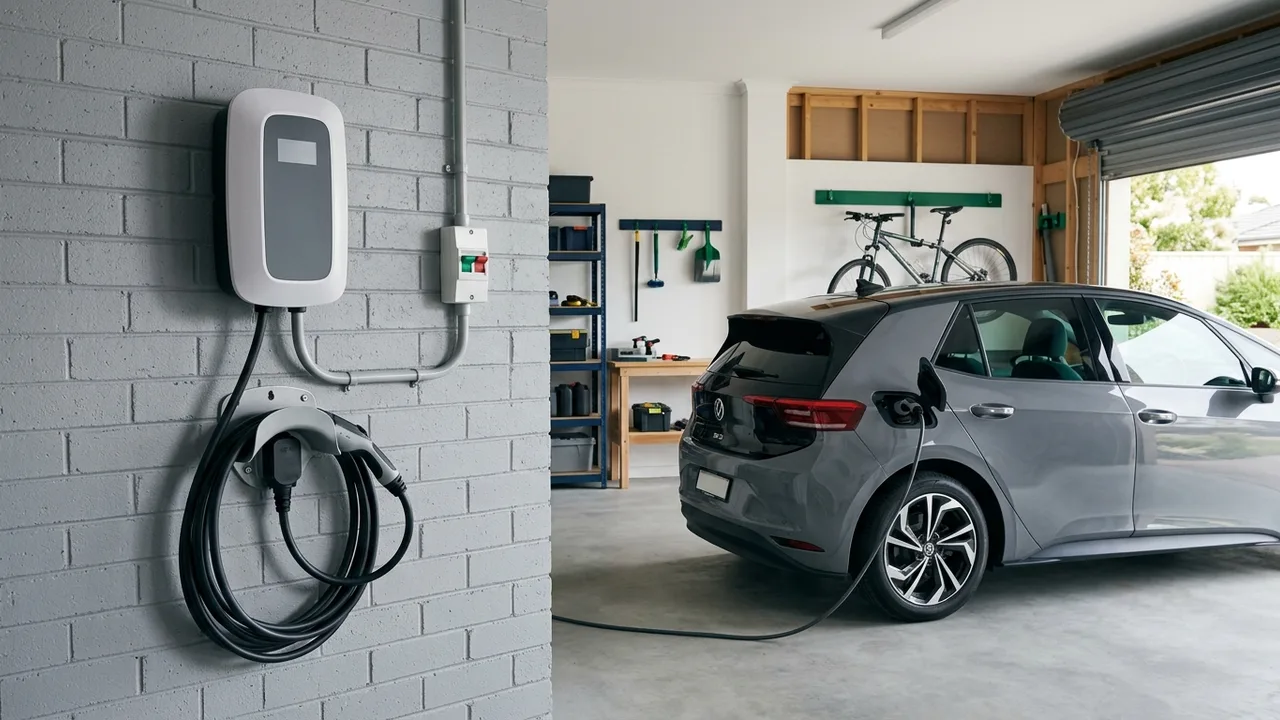
A home install means an electrician runs a new circuit from your switchboard to where you park, fits the charger and certifies it before the car's first charge. The portable cable that came with the car plugs into a normal powerpoint and trickles power in. A wall unit, such as a single-phase 7.2kW charger, is built to run for hours at a steady load.
What is included
- Charger position Close enough to the charging port for an easy reach, with a short, tidy run back to the board.
- Dedicated circuit The charger gets its own cable and breaker, sized to its rating.
- RCBO protection A single breaker guards the charger circuit against overload and earth leakage.
- Weatherproof outlet or tethered cable Fittings rated for rain and dust suit carports and open driveways.
- Switchboard and supply review Spare capacity is checked first, so other circuits stay on when the car charges.
- Certificate of Compliance Lodged electronically once the work is tested, as SA law requires.
How it works
-
Look at the board and the parking spot
The electrician inspects your switchboard, your supply and the path the cable will take from board to car.
-
Written quote
You get a written price that includes any switchboard work before anything is started.
-
Fit the circuit and charger
The cable is run, the RCBO goes in, and the charger is mounted at the agreed spot.
-
Test and certify
The circuit is tested, the charger is commissioned, and the electronic Certificate of Compliance is lodged.
Home EV charger installation in Adelaide: what the job involves
Most of the cost and effort sits in the cable run and the switchboard, not the charger itself. A garage wall right beside the switchboard is a short, simple job. A board on the far side of the house takes more cable and more care, but it is still routinely done with conduit, and the finished run can look neat.
How far can the charger sit from the switchboard?
A charger close to the switchboard keeps the job simple. Every extra metre of cable adds materials and labour, and digging or routing through walls and ceilings adds more.
That does not rule out a far-away board. The electrician can route the cable along a wall, through the roof space or underground. Trenching through paving or garden usually costs more than a run through the roof space.
If your switchboard is an original one, or the car parks on a narrow side driveway well away from it, the electrician looks at both on site. They shape the cable route and whether the board needs work.
What sits on the home charger circuit
A wall charger pulls far more power than a kettle or a heater and keeps pulling it for hours, which is why it gets a circuit to itself. Share it with an oven or heater and the breaker can trip partway through the night, leaving the car short.
The type of RCBO matters too. Not every safety switch suits an EV charger, so the electrician fits a protective device rated for EV charging.
Where the charger sits outdoors or in an open carport, the electrician uses a weatherproof outlet or a tethered cable rated for the conditions. The wiring should also follow the maker's instructions, since a charger fitted outside them can put the manufacturer warranty at risk.
Will the switchboard cope with charging at home?
Sometimes it does without changes, and sometimes it needs work. The electrician looks at how much capacity the board has spare, how many circuits it already runs and what the supply can deliver. If the board is full or old, a section may need replacing so the charger has room.
Solar and batteries add another layer. Mention your solar and battery system to the electrician so they can assess suitable charging controls. A charger set up to suit the solar system can let daytime generation fill the car instead of being exported for little return.
Choosing a charger that suits your household
A single-phase 7.2kW charger suits many daily drives, because it works through the night while the car sits at home. Going higher in output usually needs a three-phase supply, which is a bigger job than the charger itself.
A charger you already own can still go in, provided the Technical Regulator lists that make and model. An SA installer cannot fit an in-scope unit that is missing from the list.
In-scope AC wall chargers installed from 1 July 2024 must meet the Technical Regulator's EVSE technical standard. Where demand response applies, the charger can be told to slow down or pause when the network is under strain, so charging may stretch a little on a peak evening.
What decides the price of an install
The cable length, the state of the switchboard and the charger itself drive the cost. A short run from a board with spare space is the cheapest case. A long run, a trench or a board upgrade pushes the figure up.
The written quote arrives before any work and covers the charger, the circuit and any switchboard work in one price.
Tell the electrician your car model, where the switchboard sits and where you park. Then use Request an Install Quote.
Home EV charger installation options
- Single-phase wall charger A 7.2kW unit on its own circuit, run from a single-phase home supply.
- Cable run to a far switchboard Conduit or trenching carries the cable when the board sits on the far side of the garage or house.
- Solar-friendly setup A charger that can follow the solar output so daytime sun tops up the car instead of the grid.
- Installing a charger you already own Bring the charger you already have, and the electrician checks it against the Technical Regulator list before quoting.
Frequently Asked Questions
What happens on the day my home EV charger goes in?
Can a Level 2 home EV charger share a circuit with the oven or heater?
How do I choose an EV charger for my Adelaide household?
Get it priced
EV charger for your home, strata car space or workplace? Get it quoted and installed.
Share the details and we will help you take the next step with confidence.