
Three Phase EV Charger Installation Adelaide
Three-phase EV charger installation in Adelaide only pays off when your car can use the extra power. A licensed electrician can tell you what your home's supply allows.
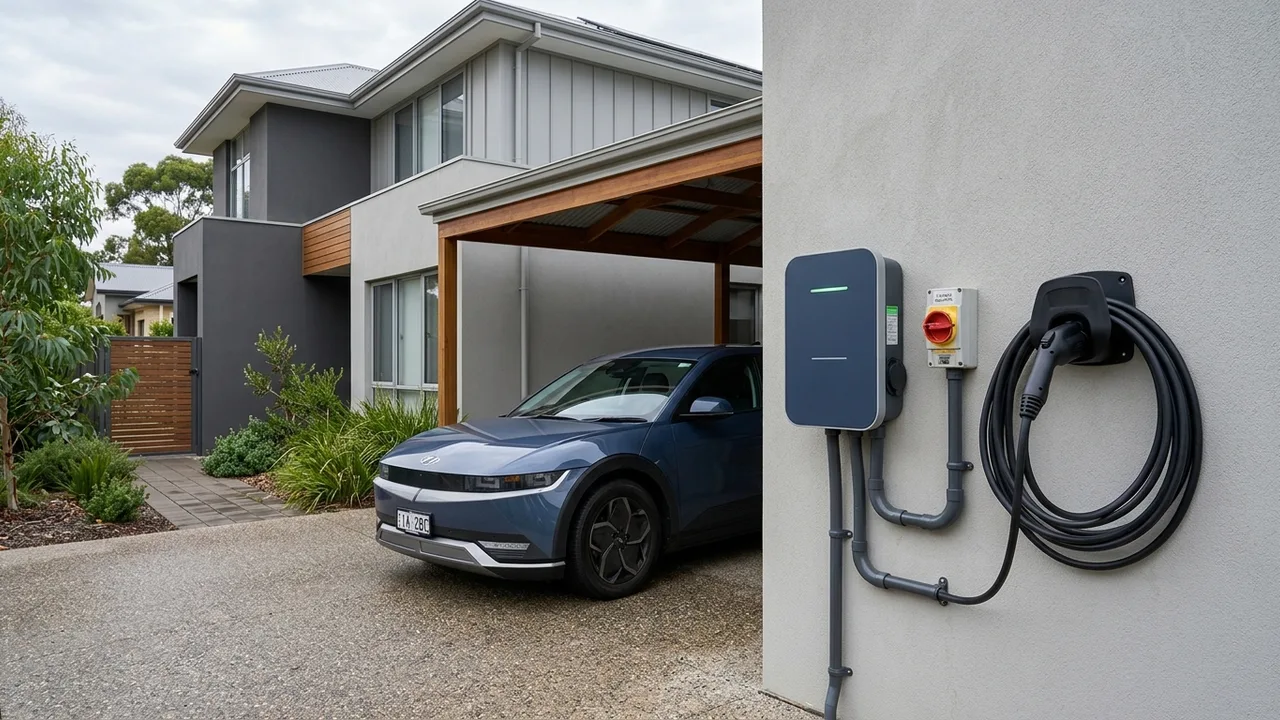
Three-phase gives a wall charger three live conductors to draw from instead of one, so it can move far more energy per hour. That suits a long daily commute, or two EVs sharing one charger in the garage. It also needs a home that already has three-phase power.
What is included
- Three-phase 22kW wall charger Suits a home with three-phase supply and a car that can accept fast AC charging.
- Supply and switchboard assessment The board and incoming supply set the ceiling, so they are looked at before a charger is chosen.
- Dedicated charger circuit A dedicated circuit supplies the charger, while the electrician checks that the incoming supply can carry charging alongside the oven and air conditioner.
- Cable run to the car Where the board is far from the parking spot, the route of the cable affects both neatness and price.
- Certificate of Compliance Every job finishes with an electronic certificate, as South Australian law requires.
How it works
-
Look at the supply and board
The electrician checks whether the home is single or three phase and how much spare capacity the switchboard has.
-
Match the charger to the car
The charger is chosen around what your car can accept, so you don't buy more than it will use.
-
Written quote
You see the price, including any switchboard work or long cable runs, before anything starts.
-
Network check
If the charger is large enough to need network sign-off, the electrician deals with it. The reason is set out under the larger chargers heading below.
-
Install and commission
The dedicated circuit is wired, the charger is mounted and tested, and the car is charged to prove it works.
-
Certificate and handover
The electronic Certificate of Compliance is issued and the charger's settings are explained.
Three phase EV charger installation in Adelaide: when 22kW is worth it
A 22kW wall charger is a Level 2 charger, meaning it runs on AC power from your switchboard rather than a roadside DC unit. On three phase it can top up a flat battery in a few hours.
That pays off for a household that does long daily distances, or one with two cars taking turns on the same charger. It matters less if the car sits in the driveway for twelve hours every night. A single-phase charger can refill a modest day of driving in that time.
Will my car use the full 22kW?
Probably not unless its manual says it accepts three-phase AC at that rate. The charger on the wall only supplies power. The car's onboard charger decides how much of it gets used, and many EVs accept only a fraction of 22kW on AC.
A car limited to a lower AC rate will charge at that lower rate whether the wall unit is rated for 11kW or 22kW. Paying for a bigger charger then buys nothing today, though it can suit a future car.
Does my home have three-phase power?
The switchboard and the incoming supply tell the story, and an electrician reading the board gives the reliable answer. A house in Kent Town, Wayville or North Adelaide may sit behind an older board, so the board is read first, and the same goes for a newer home further out.
If your supply turns out not to suit three-phase charging, the electrician can include any required supply work in the quote.
What drives the cost of a fast charger install
Three things you can see from the driveway set most of the price: how full the switchboard is, how far it sits from where the car parks, and which charger you pick.
If the board has spare capacity, the job is mostly the charger and a new circuit. If it is full or old, board work comes first.
A garage wall next to the board is a short run. A board on the far side of the house means more cable, more conduit and more labour, plus a neat route that doesn't cross the lawn or driveway.
Charger models differ in features such as scheduling and following solar output, and that shows up in the price.
Extra steps for larger home chargers
A 22kW charger pulls a heavy, steady load for hours, far more than a kettle or oven that runs briefly. The house connection and the local network have to carry that load, so a larger charger can need the network operator to assess it, or the supply to be upgraded, before it is switched on. The electrician works out which applies once the supply has been looked at.
Since 1 July 2024, in-scope AC wall chargers installed in South Australia must meet the Technical Regulator's EVSE standard, including demand-response settings. The Certificate of Compliance should list the job as an EV Charger/EVSE install, which is worth keeping for warranty or a future sale.
Solar panels and batteries with a three-phase charger
A three-phase charger can work with solar panels and batteries, but it needs to be set up for them. When charging demand is higher than the surplus solar generation, the difference comes from the grid or the battery, depending on your setup, unless the charger can throttle itself.
A solar-aware charger varies its output with what the roof is producing. Without that, a fast charger can drain a home battery in a short time. The electrician matches the charger's settings to your inverter and battery.
Getting a three-phase charger quoted
A charger you already own can be judged against your supply before it is fitted.
Not sure your car can use three-phase? Request an install quote and type in your car model, where it parks and whether solar is on the roof. That shows which charger rating is worth paying for.
Three-phase EV charger installation options
- Three-phase wall charger fit-off Mounting, wiring and commissioning a charger on all three phases at the garage, carport or driveway wall, with the position chosen around where the car parks.
- Switchboard upgrade for a larger charger The decision between new breakers, a bigger board or rebalanced circuits, so the charger and the house run together without tripping.
- Solar-aware charger setup Choosing wiring and settings that let the charger follow rooftop panels and work around a home battery.
- Existing charger fitting Installing a charger you have already bought, once the electrician has judged it against your supply and car.
Frequently Asked Questions
Do I need approval from SA Power Networks for a three-phase EV charger in Adelaide?
Should I choose a single phase or three phase EV charger for my Adelaide home?
Why is my EV charging slowly at home and how can I speed it up?
Get it priced
EV charger for your home, strata car space or workplace? Get it quoted and installed.
Share the details and we will help you take the next step with confidence.